

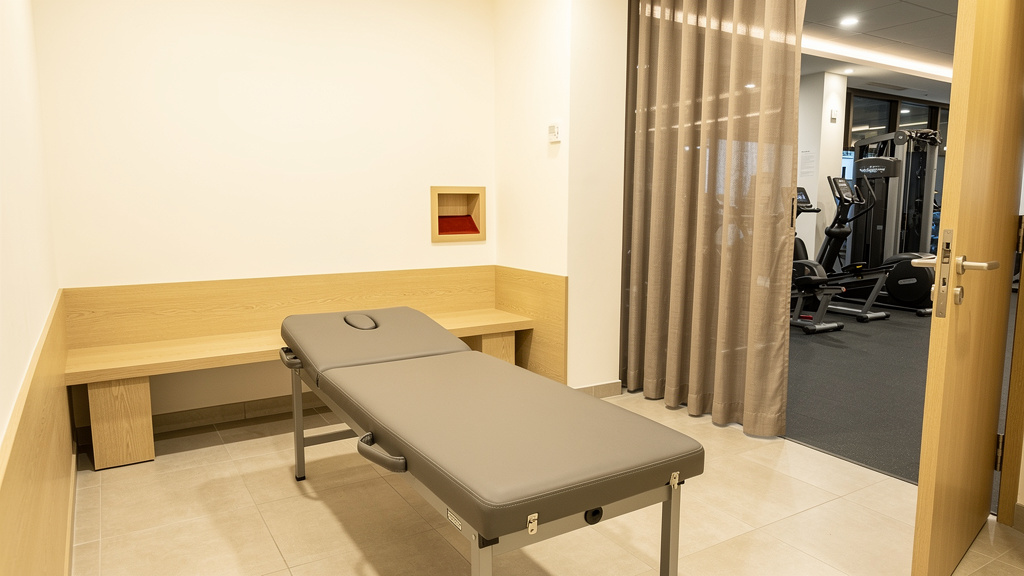
A massage robot for a gym is a machine that runs a fixed, programmed pressure session on a member’s back, shoulders, hips or legs, on the gym floor, with no appointment needed. Before signing with any supplier, a gym should get three things in writing: the force ceiling, the certification it actually claims, and what happens if the company stops trading.
That third question is not paranoia. Gym floors across Germany and Switzerland alone already carry 12 million-plus memberships between them, and every one of those members is a reason a supplier can raise money fast in a young category, and a reason the category can still get the pricing wrong. One well-funded operator raised money in a strategic round in early 2025 and filed for insolvency about a year later, owing more than $150 million. A capability sheet says nothing about which outcome you are buying into, and a gym signing a multi-year agreement is the one left holding dead floor space if the answer turns out to be the second one. For the fuller picture of what the category actually is before you get to the buying decision, see massage robots.
What does a massage robot actually do on a gym floor?
It runs a short, fixed-pressure session, usually inside a curtained or partitioned corner rather than a separate room, so a member can use it between sets or after a workout with no booking. The machine follows a programmed sequence at a pressure the member sets, within a ceiling nobody can raise, and stops the moment the member wants it to.
Sestala’s own version of this is a shop-in-shop corner inside the gym itself rather than a standalone studio: a partner-run installation under licence, sitting alongside the gym’s existing floor rather than replacing any part of it. The session on offer is Recovery 25, a twenty-five minute session built for exactly this setting, or the full Recovery 60 where the space allows a dedicated room. Neither is called a massage on Sestala’s own pages, because the category word for the room is recovery, and neither claims to fix anything: the honest claim is consistent, repeatable pressure, nothing more. A gym does not need to build a spa to carry this: a curtained corner, power, and a booking flow members already trust is the entire footprint.
Is a massage robot safe to leave with members, unsupervised?
No reputable machine in this category is meant to run fully unattended. A person sets the session up with the member and starts it: after that, the member controls pressure and can stop instantly, but the setup itself is attended, not self-service from a locked room.
The safety case rests on a small number of hard limits, not on general reassurance. Sestala’s own published figures are a 70 newton force ceiling that sits in a layer no session update can move, a 40°C thermal cap at the contact surface, a stop response of roughly 0.45 seconds, and the neck excluded from the motion path entirely. No radiofrequency, electrical stimulation, shockwave or ultrasound is used at any point, only mechanical pressure and warmth. A gym evaluating a different supplier should ask for the equivalent four numbers in writing, not a demo.
What should you ask a massage robot supplier before signing?
Ask for the force ceiling in newtons, the standard the certification actually covers, the hygiene cycle between members, and evidence the company will still exist to service the machine in three years. A supplier that answers all four in one page has done the work; one that answers with a demo video has not.
The certification question deserves the most scrutiny, because the honest answer in this category is currently uncomfortable, and it is covered in full at what the spec sheets leave out. EN ISO 13482:2014, the European standard covering physical contact between a robot and a person in a personal-care setting, requires a maker to limit the forces a machine can exert, but does not hand out a number to certify against, because no internationally recognised injury threshold existed for this contact type when the standard was written. The safety standards written for collaborative robots that share space with people, EN ISO 10218-1 and 10218-2, explicitly exclude robots built for healthcare use, public access or consumer products from their own scope. A supplier waving an ISO 10218 certificate is citing a standard about a factory robot working next to a trained operator, not a machine touching a paying gym member. The EU’s Machinery Regulation, 2023/1230, becomes mandatory on 20 January 2027 with no run-off for new machines, and it is the first regulation actually written with an interactive machine like this in view. Until then, a fixed public number the supplier will put its name to, the same discipline behind the force ceiling, is the best available substitute for a certificate that does not yet exist.
Hygiene is the second question worth pressing on, because no borrowed standard covers a shared table between sessions, unlike gym equipment generally. Ask whether the reset between members is logged by the machine itself or left to whoever is on shift, and ask to see what that log actually looks like.
| Area to check | What a good answer looks like | What a red flag looks like |
|---|---|---|
| Force ceiling | A specific number, in newtons, fixed in hardware | “Fully adjustable” with no stated maximum |
| Certification | Names the exact standard and what it actually covers | “CE certified” with no standard named |
| Hygiene cycle | Logged automatically, reviewable by the venue | Left to staff memory or a paper checklist |
| Attended setup | A person sets up and starts every session | Marketed as fully unattended from day one |
| Business continuity | Service contract terms, spare parts commitment | No answer, or a demo instead of a document |
| Neck and restricted zones | Named explicitly, enforced in hardware | Not mentioned unless you ask twice |
How much does a massage robot cost a gym to install?
Neither Sestala nor any credible supplier publishes a machine’s purchase or lease price on a public page, because the figure depends on the venue, the contract length and the service terms attached to it. What is public is the shape of the commercial relationship: Sestala runs a partner-under-licence model, with shop-in-shop corners inside gyms, hotels and practices sitting alongside its own standalone studios, and the consumer side prices as Sestala Monthly, in three sizes of 1, 2 or 4 sessions a month, with each studio setting its own session price rather than Sestala publishing one centrally.
A gym owner comparing suppliers should treat any number quoted before a site visit as provisional, and should ask specifically how the price is structured, not just what it totals: a flat venue fee, a revenue share, or a straight purchase each carries different risk if member demand runs lower than hoped in the first months.
What happens if the massage robot company goes out of business?
Ask this before signing, not after. A machine with no manufacturer left to service it becomes dead floor space inside a matter of weeks, and the category’s short history already contains one large, well-covered example of exactly that risk. Ask specifically who owns spare parts and software access if the original company folds, and get the answer in the contract rather than in conversation.
The honest context is that this is a young category and insolvency risk is real across it, not a defect unique to one brand. That is a reason to check the answer, not a reason to wait for the category to mature before using it: gyms with a floor plan and a member base to serve now do not have the luxury of waiting five years for the paperwork to catch up. A gym still deciding whether the format fits its members at all can see what a session and a studio look like from the visitor’s side at where to try a massage robot.
Common questions
Do I need staff trained to run a massage robot?
A person needs to set up and start each session, which takes a few minutes of training, but nobody needs ongoing technical skill. The machine handles the session itself once it starts, and the member controls pressure and stopping from that point on.
Is a massage robot the same thing as a massage chair for a gym floor?
No. A chair’s rollers run a fixed track built into the chair’s own frame and cannot reach a member lying on a table. A massage robot maps to the person on the table and can work the back, hips and legs the way a chair’s seated frame cannot. The full comparison is at massage robot vs massage chair.
How much floor space does a massage robot for a gym need?
Enough for a table and a person moving around it, roughly the footprint of a small private training room. Sestala’s shop-in-shop format is built specifically to fit inside existing gym floor plans rather than requiring a separate build-out.
What certification should a massage robot actually carry?
A CE mark is a baseline requirement to sell the machine in Europe at all, not proof it suits this specific use. Ask which standard the maker’s own force and safety claims are validated against, and be wary of any certificate built for industrial collaborative robots, since the standards behind those explicitly exclude healthcare, public-access and consumer use.
