

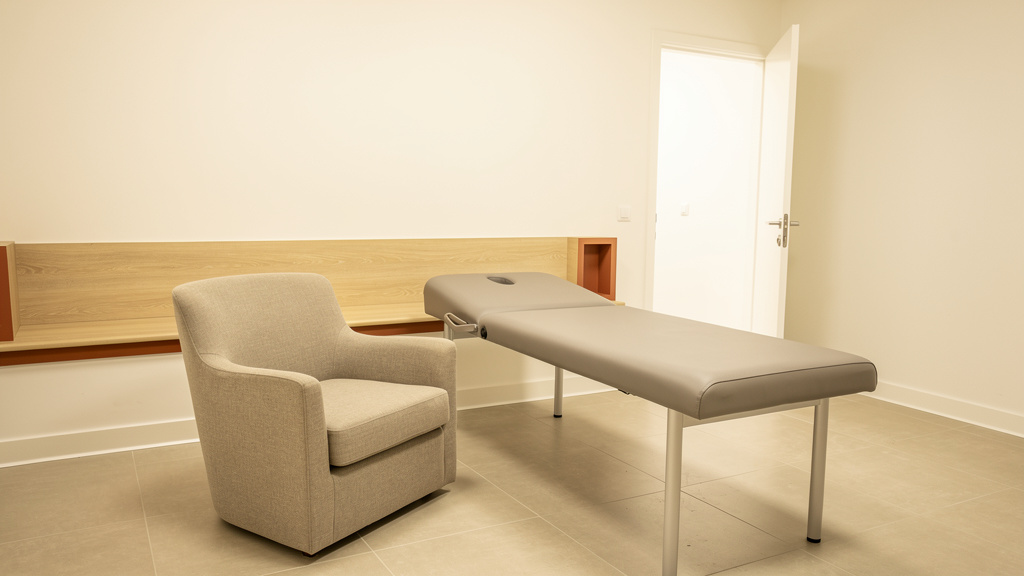
A massage chair moves rollers along a fixed track built into its own frame, the same path every time regardless of who sits in it. A massage robot maps an arm or head to the specific person lying on a table, adjusting to that body’s actual shape, and reaches the back, hips and legs a seated chair frame cannot reach at all.
Several massage-chair manufacturers have started selling chair-and-arm hybrids under the same “massage robot” name that describes the table format, and the label alone will not tell you which one you are looking at. The test that actually separates them: can it work your back and hips while you lie flat? A chair, whatever it is called, cannot. The full landscape of the category, including the practitioner and percussion-gun comparisons, is at massage robots, and what a first session on the table format actually feels like is at what is a robotic massage?
Is a massage chair a robot?
Not in the sense the category means. A massage chair is a seated mechanical device running preset roller patterns along tracks built into the upholstery, with no ability to reach an arbitrary point on the body or adapt to an individual shape. A massage robot has one or more programmable arms or heads that map to the person on the table and adjust their path to that body’s actual contours.
The confusion is understandable. Chairs have used motorised mechanisms for decades, and calling a mechanism a robot is not technically wrong, it is just a different and much simpler kind of machine than the arm-based table format the term now usually points at. A chair is closer to a washing machine’s fixed cycle than to a system that maps a moving target.
That simplicity is also the chair’s real advantage, and it is worth saying plainly rather than skipping past it. Fewer moving parts and no body-mapping system means less to go wrong, no setup step, and a lower price point that a mapped table format was never going to match. A chair earns its place in a mall or an airport precisely because nobody has to be shown how to use it. The trade-off is real: what a chair gives up in reach and adaptability, it gets back in reliability and zero-friction access.
Which format actually suits a gym or hotel floor?
Both formats appear in gyms and hotels today, and they solve different problems for the venue, not just for the person using them. A chair asks nothing of the venue beyond floor space and a card reader, and needs no attended setup. A mapped table format needs a person to set up the first session and, in most venues, a curtained or partitioned area rather than open floor.
What a venue gets back for that extra setup is the format members actually return to. A fixed roller pattern is a novelty the first few times and then becomes predictable in a way that stops earning repeat visits; a mapped session that holds a chosen pressure on the actual regions someone asked for tends to hold attention longer. The fuller buying case for a gym, including what to ask any supplier before signing, is at massage robot for gyms
What can a massage robot reach that a massage chair cannot?
A massage robot mapped to the person on the table can work the back, hips, glutes and legs while someone lies prone or supine. A massage chair’s rollers are fixed to a seated frame, so its reach is limited to the upper back and shoulders that the track happens to pass, and it cannot address the hips or the back of the legs at all.
This is a mechanical limit, not a quality difference between good and bad versions of each format. A chair was built to be sat in; a table format was built to be mapped to a body lying flat. Sestala’s own sessions, Recovery 60 and Recovery 25, run on a table for exactly this reason: a chair’s track was never going to reach the regions the format is meant to work.
Which gives more consistent pressure, a chair or a robot?
A massage chair repeats the same preset roller pattern regardless of who sits down, which is consistent but crude: it cannot tell a 150 cm frame from a 190 cm one. A massage robot maps to the individual body first, then holds a pressure the person chooses within a fixed ceiling, so the consistency is both to the person and session to session.
Sestala’s published figures show what that ceiling looks like in practice: a 70 newton force limit fixed in hardware, ten pressure levels a member can choose within it, and a stop that halts the machine in roughly 0.45 seconds. A chair’s presets are usually two or three fixed intensities with no equivalent hard ceiling published, because the mechanism does not need one: a roller track cannot exceed its own preset travel.
The practical difference shows up mid-session, not on a spec sheet. On a chair, changing your mind about pressure usually means stopping the cycle and picking a different preset from the start. On a mapped table format, pressure moves up or down while the session keeps running, and the change is immediate rather than requiring a restart. Neither approach is wrong for what it was built to do, but only one of them was built around the idea that a person’s comfort changes minute to minute rather than being decided once at the start.
Which costs less, a massage chair or a massage robot session?
An unsupervised express chair, the kind found in malls and airports, typically runs €15-30 for fifteen to twenty minutes. A robotic table session is a different product at a different price point, usually sold through a studio or gym membership rather than a coin slot, and priced by the venue rather than published centrally by any manufacturer.
The honest comparison is not cheaper versus pricier, it is different job versus different job. A chair is built for a spontaneous fifteen minutes with no booking and no undressing. A robot session is built to be a standing part of someone’s week, at a length and a pressure that a fifteen-minute chair cycle was never designed to deliver. A single chair cycle and a single robot session are not substitutes for each other any more than a coffee-machine espresso and a sit-down coffee are, even though both involve a cup of coffee. What actually drives a session’s price on the robotic side, and why the arithmetic looks different from a booked appointment, is covered in full at what does a robotic massage cost?
Access matters as much as price. A chair needs nothing beyond a coin slot or a card reader and can sit in a corridor unattended. A mapped table format currently reaches far fewer places: Sestala’s own studios, for one, open from 2027 in Germany, Switzerland and the United Kingdom, through partner-run shops and shop-in-shop corners inside gyms, hotels and practices, with a waitlist standing in for a studio address until then. A chair, in that sense, wins on availability today by default, simply by already existing everywhere a robot has not yet reached.
| Massage chair | Massage robot | |
|---|---|---|
| Mechanism | Rollers on a fixed track in the frame | Arm or head mapped to the person’s body |
| Reaches hips and legs while lying flat | No | Yes |
| Adapts to individual body shape | No, same path for everyone | Yes, mapped before the session starts |
| Pressure control | Two or three fixed presets, typically | Chosen by the person within a fixed ceiling |
| Force ceiling published | Rarely | Sestala publishes 70 newtons |
| Undressing needed | No | Depends on the venue and format |
| Typical setting | Malls, airports, waiting areas | Gyms, studios, hotels |
| Booking needed | No, coin or card operated | Usually, though gym-floor formats allow walk-ins |
Common questions
Is a massage chair a type of massage robot?
No, not in the sense people search for the category today. A chair runs fixed rollers on a preset track and cannot adapt to an individual body or reach the hips and legs while someone lies flat. A massage robot maps to the person on a table and can do both.
Why do some massage chairs get marketed as massage robots now?
Because the term carries momentum in search and in marketing, and a chair with a small arm attachment can technically be described as robotic. The mechanism, not the label, is what tells the two apart: ask whether it can reach a prone back and hips, not what the box calls itself.
Does a massage robot hurt more than a massage chair?
Not by design. A massage chair’s pressure comes from fixed roller presets with no published ceiling. A massage robot’s pressure is chosen by the person, within a hard limit fixed in the machine, 70 newtons on Sestala’s own machines, so the person controls how firm it gets within a known, unmovable maximum.
Can I use a massage chair and a massage robot for the same reason?
Both may help with the loaded feeling of tight shoulders or a hard training week, in the same careful sense: potential, not a promise, and neither replaces a practitioner’s judgment when something actually hurts. A chair suits a spontaneous fifteen minutes; a robot session suits a longer, mapped session as a standing part of a week.
