

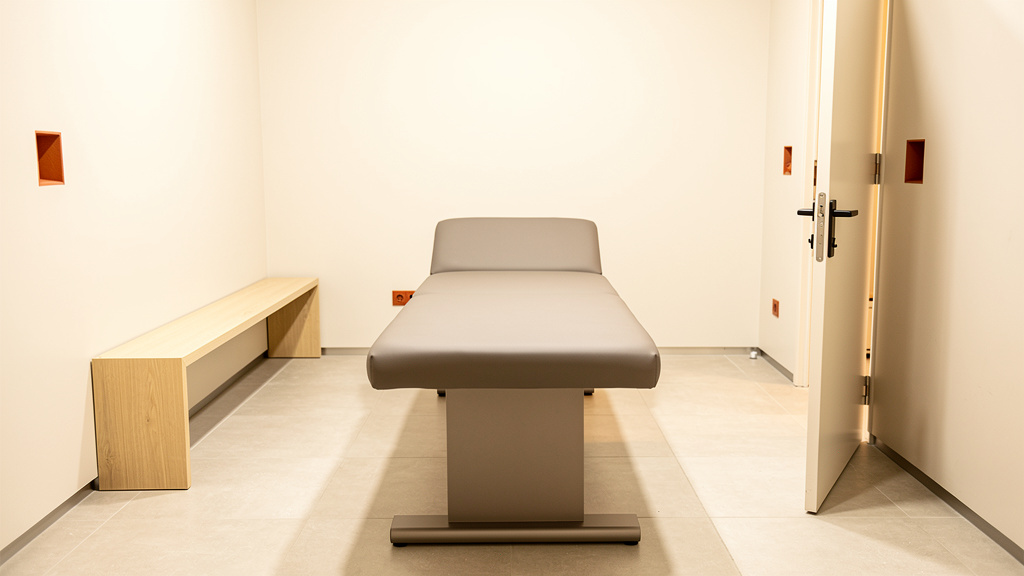
A robotic massage is a session delivered by a machine instead of a person: you lie down, a programme runs over your back, shoulders, hips or legs at a pressure you choose, for a fixed length, and you can change the pressure or stop the session at any second. It sits apart from a massage chair and from a practitioner - a third format built around consistency rather than judgement.
The first surprise is how little there is to do. You put your bag down, you lie on the table, and the newness of it is spent within a couple of minutes. What most people notice after that is not the machine itself but the evenness of it: the same pressure at the start of the session as at the end, which is precisely the thing a tired hand, at minute fifty of a long day, cannot always promise.
How does a robotic massage session actually work?
A robotic massage session runs on a defined programme, at the pressure you set, adjusted in real time to your body’s shape as sensors track it. Before the session starts, the machine establishes your basic proportions, then follows a set sequence of movements over the chosen regions - most often back, shoulders, hips and legs. You keep a control within reach the entire time.
Two things stay fixed regardless of the specific machine. The pressure you choose is always capped by a ceiling the machine itself cannot exceed, set in a layer separate from the programme software. And the stop is instant: press it, and the machine halts mid-movement and stays halted until you say otherwise. Sestala’s own published limits illustrate the shape of this design: a 70 N force ceiling, a 40°C thermal ceiling at the contact surface, and a stop response of roughly 450 milliseconds, all fixed outside the session software (sestala.com/industry). Session lengths vary by venue; Sestala’s own two formats are Recovery 60 and Recovery 25.
What does a robotic massage actually feel like?
Firmer and more even than most people expect, less personal than a practitioner’s hands, and strangely repeatable - that is the shape of it once the newness wears off. The evenness is what stays with people: the machine does not tire, does not rush the last few minutes, and runs the same programme today that it ran last time.
That consistency is also the honest trade-off. A practitioner adjusts what they are doing based on what they notice in the moment - a knot that was not mentioned, a spot that reacts more than expected. A programmed session does not do that; it runs the sequence it arrived with, over the regions it was set to cover, at the pressure chosen before the session began. If one side of the body is carrying more tension than the other, the programme still runs the identical sequence on both sides, because it executes the plan it started with rather than revising that plan as it goes, session after session, week after week.
People who value the evenness above all become repeat users of the format, precisely because a Tuesday session feels like a Friday one. People who want to be read and adjusted for in real time keep a practitioner for that, and nothing about the machine format is designed to replace that judgement - the two are answers to different questions, not competing versions of the same answer. Most people who use the format regularly are not choosing it instead of a practitioner; they are choosing it for the weeks when a practitioner’s hands are not the real obstacle, the appointment itself is.
How is a robotic massage different from a massage chair?
| Massage chair | Robotic massage | Practitioner | |
|---|---|---|---|
| Where it works | Fixed rollers, mostly upper back | Programmed regions, mapped to your shape | Anywhere, adjusted as they go |
| Adapts to your body | Minimal | Scans your shape, follows the programme | Fully, in real time |
| Consistency | High but crude | High and precise | Varies by day and person |
| Judgement | None | None | The entire point |
| Force ceiling | Preset patterns only | Fixed in a separate hardware layer | None guaranteed |
A massage chair’s rollers move along a track built into the chair itself, so the experience depends on how well your shape happens to match the designer’s assumptions. A robotic massage maps to your specific body and holds a chosen pressure at a chosen place - things a seated chair frame cannot do regardless of what its marketing now calls it. Neither format brings judgement to the session; that is what a practitioner is for. The fuller comparison across all the machine formats, not just the chair, is in massage robot or massage chair: what is actually different?
Why is the robotic massage format spreading now?
The robotic massage format is spreading because the hands-on workforce cannot grow fast enough to meet demand, not because people have stopped wanting a practitioner’s hands. A November 2024 industry study found Germany short by 11,584 physiotherapy professionals, with an average of 148 days to fill a single vacancy - a delivery bottleneck no amount of extra appointment slots can fix on its own.
At the same time, the venues where a short session fits best are already busy. Germany closed 2025 with 12.36 million gym members across 9,647 facilities, and a machine-delivered session that requires no separate appointment meets that existing footfall directly, on the gym floor, rather than asking someone to create a new occasion for it. AMTA’s own 2026 consumer fact sheet found 23% of men and 19% of women had received a massage in the past year, which is the underlying demand a scarce workforce cannot fully answer alone.
What actually keeps a robotic massage from pressing too hard?
A hard force ceiling, fixed outside the software that plans the session, is what keeps a robotic massage from ever exceeding a set limit - not a promise, a setting someone could later raise, or good intentions, but a separate layer of the machine that no update can touch. On machines built this way, the person deciding what a good session looks like and the part of the system deciding what is permitted are architecturally different pieces, and only a physical intervention by a qualified technician can move the ceiling.
The standards picture behind this is still developing. EN ISO 13482:2014, the harmonised European standard for physical contact between a robot and a person, requires manufacturers to limit contact force but does not supply a specific number - it states plainly that no internationally recognised pain or injury threshold existed for this use case when it was written. The most detailed public research on human pain thresholds under mechanical pressure is Germany’s DGUV pain-threshold register, roughly 9,000 measurements across 29 body locations on around 100 subjects, which now informs broader thinking on safe robot contact force. Why the ceiling has to sit in its own layer rather than as a setting, and what that means for how a machine is actually built, is the whole subject of the force ceiling essay.
Common questions
Do you undress for a robotic massage?
It depends on the format, and it is worth checking before you book. Some machines work through a close-fitting garment the venue supplies, which lets a short session fit inside a gym visit without a shower or a changing-room turnaround. Others work on skin under a cover, the way a massage table normally does. A Sestala session is the second kind: you undress to your comfort and are draped throughout, uncovered only where the machine is working.
Can a robotic massage replace a practitioner?
No. The machine repeats a programmed sequence precisely; a practitioner notices what the programme cannot know and adjusts accordingly. Many people use both: the machine for a consistent rhythm - see how often should you get a massage? for where that rhythm actually lands - and a practitioner when something specific needs attention.
How much does a robotic massage session cost?
Pricing varies widely by venue and format, and the category’s short public history already shows how much: reported consumer prices for one well-known US format ranged from under USD 30 to well over USD 100 for a session at different venues in 2025 and 2026. Sestala does not publish prices on its own pages, because each studio partner sets its own. The fuller picture of what actually drives the cost of a session is in what does a robotic massage cost?.
Is a robotic massage safe for everyone?
Not automatically. Anyone for whom firm pressure would warrant a doctor’s opinion first - during pregnancy, after a recent injury or operation, or with a condition that makes firm pressure unwise - should check with a doctor before booking. A machine runs its programme precisely and repeatedly, which is exactly why checking beforehand matters more, not less. For the full picture of what the category as a whole can and cannot do, see massage robots: what they are and what they cannot do.
